Template by:
Free Blog Templates

Sunday, February 14, 2010

Porsche Carrera GT

Porsche Carrera GT

Developed in 1999, Porsche Carrera GT, manufactured by Porsche of Germany, is priced at $440,000 dollars. It is well worth its price if we count the 5.7 litre V10 engine producing 612 DIN (605 SAE) horsepower (450 kW) and the acceleration from 0 to 100 km/h (62.5 mph) in 3.9 seconds, touching a maximum speed of 330 km/h (205 mph).

The design is stunning too, Carrera GT has a 5 colors paint schemes that includes: black, guards red, fayence yellow, basalt black, GT silver and seal grey.

The innovating thing about this car is the way that its engine is placed: with the use of a clutch made of a high-tech ceramic material, it`s allowing the engine to sit lower in the chassis than in any other super car. This feature is not only making the Carrera GT a road car with the looks of a race one, but also improves its aerodynamics and lowers its center of gravity.

Porche Carrera GT does have traction control even if, like some of its competitions, doesn`t use electronic driving aids such as dynamic stability control.

Specifications

Vehicle Type: - 2-door convertible, production car
 

Price: - $440,000
 

Configuration: - Mid Engine / RWD
 

Engine: - V10
 

Displacement: - 5733 cc
 

Torque: - 435 lb-ft at 5750 rpm
 

Horsepower: - 612 bhp at 8000 rpm
 

Transmission: - 6-Speed Manual
 

Length: - 181.6 inches
 

Width: - 75.6 inches
 

Height: - 45.9 inches
 

Weight: - 3042 lbs
 

0-60 mph: - 3.8 sec
 

Top speed: - 205 mph

Mercedes-Benz SLR McLaren Roadster

Mercedes-Benz SLR McLaren Roadster 

The Mercedes-Benz SLR McLaren Roadster is a super sports car with high performance and stylish looks. The cost for owning this car is approximately $495,000.

The body of the Mercedes-Benz SLR McLaren Roadster is made of carbon fiber, due to this, the car is of less weight and provides more security for the passengers.

The Mercedes-Benz SLR McLaren Roadster features a Supercharged V8 engine with a capacity of 5439 cc. The engine delivers an output power of 617 bhp at 6500 rpm and 575 lb-ft torque at 3250 rpm. The car reaches the speed of 60 mph in 3.8 seconds and the top speed is about 206 mph. The car features 5-speed Automatic transmission and the gear shifts can be performed easily and smoothly even at higher loads.

The car has an open top which is operated by the touch of a button. The safety features in the car includes the air brakes, tire pressure monitoring system and air bags.

The exteriors feature the stylish open top and the interiors feature the air conditioning system, sporty steering wheel and the BOSE sound system.

Specifications

Vehicle Type: - 2-door convertible, production car
 

Price: - $495,000
 

Configuration: - Front Engine
 

Engine: - Supercharged V8
 

Capacity: - 5439 cc
 

Torque: - 575 lb-ft at 3250 rpm
 

Horsepower: - 617 bhp at 6500 rpm
 

Transmission: - 5-Speed Automatic
 

Length: - 183.3 inches
 

Width: - 75.1 inches
 

Height: - 49.3 inches
 

Weight: - 4023 lbs
 

0-60 mph: - 3.8 sec
 

Top speed: - 206 mph

Koenigsegg CCX

Koenigsegg CCX

The Koenigsegg CCX is a supercar which features a breath taking CC shape and it is priced at $545,568

The word “CCX” means “Competition Coupe X” and the CCX was launched marking the 10th anniversary of Koenigsegg. The body of the car is made of aluminum and it features the fog lamps, front lamps, brake cooling system, optimal headlights, ICEM Surf CAD software and it has 50 mm space at the headroom, which makes it as the most spacious car.

Koenigsegg CCX has a Supercharged V8 engine with a capacity of 4700 cc. The engine delivers an output power of 806 bhp at 6900 rpm and 678 lb-ft torque at 5700 rpm. It can reach from 0 to 60 mph in 3.2 seconds and the top speed is about 245 mph. The CCX features 6-speed Manual transmission and the gear shifts can be performed easily and smoothly even at higher loads.

The CCX features the carbon fiber wheels with ceramic discs which consist of eight piston calipers in the front and six piston calipers in the rear.

The exteriors feature the fog lamps, front lamps and optimal headlights. The interiors are mainly designed of carbon fiber and it features the leather seats, air conditioning system and the stylish dash board.

Specifications

Vehicle Type: - production car, two-door Coupe
 

Configuration: - Mid Engine
 

Engine: - Supercharged V8
 

Capacity: - 4700 cc
 

Torque: - 678 lb-ft at 5700 rpm
 

Horsepower: - 806 bhp at 6900 rpm
 

Transmission: - 6-Speed Manual
 

Length: - 169.0 inches
 

Width: - 78.6 inches
 

Height: - 44.1 inches
 

Weight: - 2601lbs
 

0-60 mph: - 3.2 sec
 

Top speed: - 245 mph
 

Price: - $545,568

Saleen S7 Twin Turbo


Saleen S7 Twin Turbo 
The Saleen S7 is a high performance race car which features the powerful Twin-Turbo V8 engine.

The body of the Saleen S7 is made of aluminum and carbon fiber, as a result of this, the car is of less weight. The Saleen S7 features aluminum dampers and stabilizer bars at the front and rear. This ultimate supercar is priced at $550,000 and it can reach a top speed of 248 mph.

The Saleen S7 features a Twin-Turbo V8 engine with a capacity of 7000 cc. The engine delivers an output power of 750 bhp at 6300 rpm and 700 lb-ft torque at 4800 rpm. The Saleen S7 reaches the speed of 60 mph in 3.2 seconds and 100 mph speed in about 6.2 seconds. The Saleen S7 features 6-speed Manual transmission and the gear shifts can be performed easily and smoothly even at higher loads.


The powerful supercar has a 19-inch alloy wheels at the front and 20-inch alloy wheels at the back. The wheels are wrapped with Michelin Pilot Sport PS2 tires and the wheels features the 15-inch vented discs at the front and 14-inch vented discs at the rear.

The exteriors feature the stylish body structure, headlights and tail lights. The interiors feature the leather seats, air conditioning system, power door locks, power windows and TV, DVD, FM system.

Specifications

Vehicle Type: - production car, two-door Coupe
 

Configuration: - Mid Engine
 

Engine: - Twin-Turbo V8
 

Capacity: - 7000 cc
 

Torque: - 700 lb-ft at 4800 rpm
 

Horsepower: - 750 bhp at 6300 rpm
 

Transmission: - 6-Speed Manual
 

Length: - 188.8 inches
 

Width: - 78.4 inches
 

Height: - 41.0 inches
 

Weight: - 2950 lbs
 

Wheelbase: - 106.3 inches
 

 0-60 mph: - 3.2 sec
 

0-100 mph: - 6.2 sec
 

Top Speed: - 248 mph
 

Price: - $555,000


SSC Ultimate Aero

SSC Ultimate Aero

The SSC Ultimate Aero is a powerful engine sports car manufactured by Shelby SuperCars. The precious SSC Ultimate Aero TT is the world’s fastest production car, which travels at a top speed of 257 mph.

The new version known as 2009 SSC Ultimate Aero has been modified where some changes have been added to the exteriors, interiors, and the increase of horsepower about 15%. The most important change is the single piece aluminum block engine that improves the oiling capabilities and structure of the engine, so that the SSC Ultimate Aero produces an output of about 1287 horsepower.

At the cost of $654,000 and with a newly designed engine, the Ultimate Aero can reach a maximum speed of 270 mph, which is a world record speed. It can reach from 0 to 60 mph in 2.7 secs. The front face of the car has been redesigned with improved aerodynamics and carbon fiber which draws 20% additional air to the radiators for better cooling.

The AeroBrakeTM system has been introduced in this car which is a rear spoiler system that can be controlled by a switch. The spoiler speed can be set depending on the pressure applied on the brake pedal.


The interiors are mostly designed of carbon fibers that bound the doors, steering column, speedometer and tachometer.

Specifications

Vehicle Type: -Production car, two doors coupe
 

Configuration: - Mid Engine/ RWD
 

Price: $654,000
 

Engine: - Twin-Turbo V8
 

Displacement: - 7000 cc
 

Horsepower: - 1287 bhp @ ---rpm
 

Max RPM: - 7200 rpm
 

Transmission: - 6-speed Manual
 

Width: - 82.7 in
 

Length: - 176.2 in
 

Height: - 43.0 in
 

Wheelbase: - 105.2 in
 

0-60 mph: 2.7 secs
 

Top speed: - 270mph

Saturday, February 13, 2010

Pagani Zonda C12 F

Pagani Zonda C12 F

First appeared at Geneva at a Auto Show in 2005, the all carbon fiber super car can reach 60 mph (100 km/h) in just 3.5 seconds. With power of 443 kW/594 hp, and a top speed that passes 215 mph (346 km/h), Zonda F makes Pagani manufacturer to be at the level of another independent of famous super cars manufactures like Porsche, Lamborghini or Ferrari.

A car made by combining the sensibility of Juan Manuel Fangio, a F1 world champion 5 time in a row, about all that is related with technicality and the advance technology of Pagani, has a lot to offer, from the power to weight ratio of 384 W/kg, the six-speed manual transmission, the aerodynamic vents all around, not at least the carbon/ceramic brakes that allows the Zonda F to be on the top list of the cars with spectacular braking from 180 mph to 0 mph.

The V12 engine is a lot cooler because of the design of the car, larger in front, 7.3 liter Mercedes-Benz engine can reach now 620 bhp and gives almost 561 pound-feet of torque peaking at 4000 rpm. It has a length of 174.6 inch, a width of 80.9 inch and a height just about 44.9 inch.

Even if it's said to be a priceless super car, it will be on the market in 2008 at a base price of $667,321.

Ferrari Enzo

Ferrari Enzo

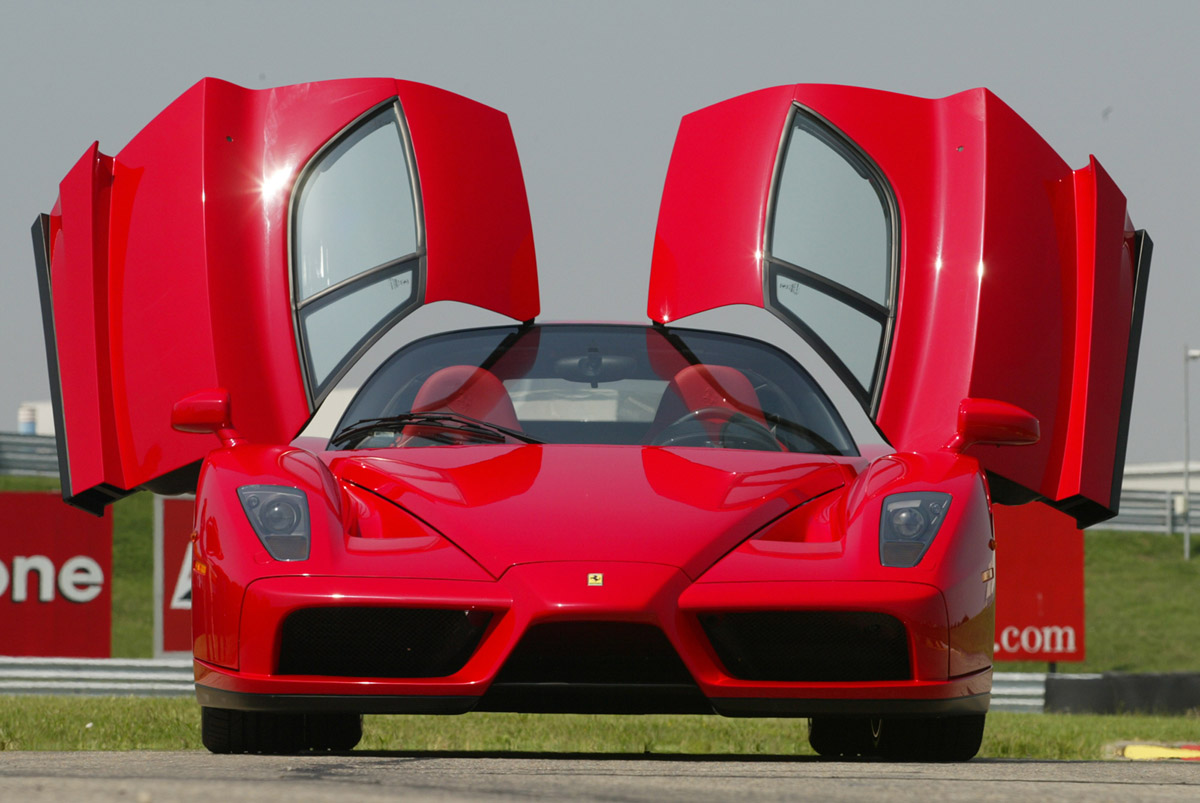
The Ferrari Enzo, named after the Ferrari's owner, is a high performance sports car which is well noted for its styling features. Initially, the Ferrari Enzo cost $670,000 and only 399 units were ever produced, but due to its high demand and limited supply, the price of the Ferari Enzo increased every time someone crashes and it is currently estimated at over $1,000,000.

The body of the Ferarri Enzo is made of carbon fiber, as a result, the car is of less weight. The car features aerodynamic subsystems for better safety and performance. It is also equipped with active suspension for comfort riding in the sports mode.

The Ferrarri Enzo features a V12 engine with four valves per cylinder. The engine displacement is about 4700 cc and it delivers an output power of 660 bhp and 485 lb-ft torque. The Ferrari Enzo reaches the speed of 60 mph in 3.4 seconds and the top speed is about 217 mph. The Ferrari Enzo features 6-speed Semi-Automatic transmission and the gear shifts can be performed easily and smoothly even at higher loads.

The wheels are wrapped with Bridgestone tires and it features carbon ceramic discs with six piston calipers. The car also features Anti Braking System and power steering.

The exteriors feature the stylish body structure, headlights and tail lights. The interiors are mostly designed of carbon fiber and it features the air conditioning system, navigation system and the optional launch control.


Specifications

Vehicle Type: - production car, two doors coupe
 

Configuration: - Mid Engine
 

Engine: - V12
 

Capacity: - 5988 cc
 

Torque: - 485 lb-ft
 

Horsepower: - 660 bhp
 

Transmission: - 6-speed Semi-Automatic
 

Wheelbase: - 104.3 inches
 

Length: - 185.1 inches
 

Width: - 80.1 inches
 

Height: - 45.2 inches
 

Weight: - 3020 lbs
 

0-60 mph: - 3.4 sec
 

Top speed: - 217 mph

McLaren F1

McLaren F1

McLaren F1 is the most powerful supercar produced by McLaren between the years 1994-1998, from the 100 cars: 65 are street versions, 5 are LMs (which was build to honor victory at Le Mans in 1995) and 3 are Gts (the road versions of the 1997 F1 GTR racing car) and 28 F1 GTR made for the roads.
 
The Chief Engineer Gordon Murroy`s concept refers to the use of expensive materials like: carbon, titanium, gold and for the first time, the use of carbon fiber monocoque chassis.

Power? Here is a good question, the car has the power output at 627 horsepower or has an imperial HP. The super car is powered by an 6 L V12 engine built by BMW, 627 HP at 7400 rmp, same as road car version.

The car has a top speed of 386 km/h or 240 mph (very good speed for 1994) and can reach a speed of 100 km/h in 3.2 seconds, 200 km/h in 6.7 seconds and 300 km/h in 30 seconds. The McLaren F1 was the fastest car in the world until Bugatti Veyron was introduced.

When it was first introduced, it was priced at $970,000. This type of car is not produced anymore and it is very rare to find one of these on the market.

Specifications

Vehicle Type: - production car, two doors coupe
 

Price: - $970,000
 

Configuration: - Mid Engine / RWD
 

Engine: - V12
 

Capacity: - 6064 cc
 

Torque: - 479 lb-ft at 4000 rmp
 

Horsepower: - 627 bhp at 7400 rpm
 

Transmission: - 6-speed manual
 

Wheelbase: - 107
 

Length: - 168.9 inches
 

Width: - 71.7 inches
 

Height: - 44.9 inches
 

Weight: - 2513 lbs
 

0-60 mph: - 3.2 sec
 

Top speed: - 240 mph


Lamborghini Reventon


Lamborghini Reventon
Lamborghini presents the ultimate driving machine among open-top two-seaters – the Reventón Roadster is a sports car of breathtaking fascination, menacing power and uncompromising performance. The 6.5 liter twelve-cylinder generates 493 kW (670 PS), catapulting the Roadster from 0 to 100 Km/h (0 to 62 mph) in 3.4 seconds and onwards to a top speed of 330 KM/h (205 mph). The open-top Reventón is not only one of the fastest, but also one of the most exclusive cars in the world – Lamborghini has limited the series.

The Lamborghini Reventón is not destined to remain a one-off. Less than 20 Lamborghini friends and collectors will be able to own this extraordinary car and, naturally, enjoy the incomparable pleasure of driving it.

Each Reventón Roadster will be sold for 1.1 Million Euro (without taxes). Deliveries will begin October 2009.

"The Reventón is the most extreme car in the history of the brand," comments Stephan Winkelmann, President and CEO of Automobili Lamborghini S.p.A. "The new Roadster adds an extra emotional component to our combined technological expertise – it unites superior performance with the sensual fascination of open-top driving." The Reventón Coupé was presented at the 2007 IAA in Frankfurt and was sold out immediately.

Open-top sports cars are a tradition at Lamborghini that stretches back over 40 years. In 1968, the company from Sant'Agata Bolognese built a Miura without a fixed roof as a one-off. The Diablo Roadster appeared in 1995 with its targa roof anchored to the engine cover.

Sculpture with extreme dynamics

All Lamborghinis are created with an avantgarde approach to design; a fast-moving technical sculpture. The Reventón Roadster is derived from the same creative thinking as the Coupé. Its designers found their inspiration in aviation – the aggressive wedge shape evokes images of fighter jets.
The powerful arrowhead form at the front, the mighty air intakes pulled way forward, the broad side skirts, the upwards opening scissor doors and the rear end with its menacing edges – the Roadster is clad in a design of maximum functionality and spectacular clarity. Details set stylish accents, such as headlamps featuring bi-xenon units with LEDs forming the daytime running lights and indicators. The rear lamps are also equipped with LEDs.

Like the Coupé, the Reventón Roadster measures 4700 mm (185 in.) long. It has a wheelbase of 2665 mm (105 in.) and is 2058 mm (81 in.) wide and 1132 mm (45 in.) high. The driver and passenger seating positions are low and sporty, separated by a substantial central tunnel.

Behind the two seats are two hidden pop-up bars that deploy upwards in just a few hundredths of a second in the event of an imminent rollover. A fixed, horizontal wing-shaped member behind the seats bears the third brake light. The design of the Roadster's long back is also quite distinct from that of the Coupé. The engine bonnet is virtually horizontal and a total of four windows made from glass provide a view of the mighty V12 in all its technical elegance.

Stiff bodyshell base

The base bodyshell of the Reventón is already so stiff that the Roadster requires only minimal reinforcement. It has a dry weight of only 1690 Kg (3,725 lbs.), just 25 Kg, (55 lbs.) more than the Coupé.

Like the Coupé, the cell of the Roadster is made from high-strength steel profile and carbon components joined with specialist adhesive and rivets. The bodyshell is made almost entirely from carbon fiber elements, with sheet steel used only for the outer door skins.

Exclusive grey paintwork

A unique paint finish completes the razor sharp design language of the Lamborghini Reventón Roadster. For this exclusive special edition, designers have created a new shade of matt grey called Reventón Grey. As for the Reventón Coupé, which is a slightly different shade of grey, this is a matt paint finish that, in the sunlight, displays an unexpected impression of depth thanks to its special metal particles.

The wheels of the Reventón Roadster also incorporate the interplay of matt and glossy elements. The five spokes of the rims each bear a Y-form, and on each spoke are mounted small crescent-shaped wings made from matte carbon. These provide not only an unusual visual impact, but also a turbine effect that further improves cooling of the mighty ceramic brake discs.

Aircraft-style displays

The interior of the Reventón Roadster conveys the same powerful design as the exterior. The cockpit is structured with technical clarity, the interfaces arranged for functionality. Like a modern aircraft, the open two-seater no longer has classic analogue instrumentation – instead, information is delivered via two transreflective and one transmissive liquid-crystal displays.

The driver can switch between two modes at the touch of a button – one digital view with illuminated bars and one level with classic round dials, albeit with changing color graphics. Centrally located at the top of the display is the G-force meter. It represents the intensity of the forces acting on the Reventón Roadster under acceleration, braking and heavy cornering; the same format used in Formula 1.

The instruments are mounted in a casing machined from solid aluminum which is housed in a carbon fiber dashboard. The interior displays uncompromisingly clean craftsmanship and features a host of carbon fiber applications – e.g. on the center tunnel – aluminum, Alcantara and leather. The central panels and the seat cushions are perforated, with precision stitching gracing their outer edges.

Lamborghini has equipped the Reventón Roadster with full options.

An icon of engine design

The twelve-cylinder engine that powers the Reventón Roadster is a Lamborghini icon – and the technical feature that defines the character of the car. It is one of the world's most powerful naturally-aspirated engines. With a compression ratio of 11 : 1 and a displacement of 6496 cc (396.41 in3,) it generates 670 PS (493 kW) at 8,000 rpm. Its maximum torque of 660 Nm (487 lb-ft) kicks in at 6,000 rpm.

The V12 engine is a masterpiece of Italian engineering. Two chains drive its four camshafts that, in turn, operate the 48 valves. Together with the three-phase adjustable intake manifold, the variable valve timing delivers a meaty torque build-up. Dry sump lubrication ensures that the hi-tech power unit has a constant supply of oil, even under heavy lateral acceleration. The absence of the oil sump means a low mounting position – benefitting the car's outstanding handling characteristics.

The V12 catapults the Reventón Roadster from 0 to 100 Km/h (0 to 62 mph) in 3.4 seconds and onwards to a top speed of 330 Km/h (205 mph). It reacts with the eagerness of a racing engine to input from the right foot, revving to 8,000 rpm and beyond, and performing a symphony that sends shudders along the spine. The deep booming bass, the powerful mid-range and the exultant horn section play music that, once heard, can never be forgotten.

All-wheel drive for maximum traction

In classic Lamborghini style, the aluminum engine is mounted longitudinally in front of the rear axle, with the transmission ahead of it beneath the center tunnel. This layout results in 58 percent of the overall weight being borne by the rear wheels – ideal for a powerful sports car.

This layout accommodates the Viscous Traction permanent all-wheel drive. Under normal conditions, it sends the vast majority of the driving force to the rear wheels. Should they begin to spin, the central viscous coupling sends up to 35 percent of the power via an additional shaft to the front axle. Limited-slip differentials are located there and at the rear axle with 25 and 45 percent lock respectively.

Lamborghini introduced the all-wheel drive principle with the Diablo. The reason back then was just as clear as it is today - four driven wheels grip far better than two, and the more powerful the engine, the greater the impact of this fundamental law of physics.

Also standard on the Reventón Roadster is the e.gear automated six-speed sequential manual transmission. The driver controls the gear shift, which is activated hydraulically via two steering wheel paddles. In addition to the "Normal" mode, the system offers a "Corsa" and a "low adherence" mode. The driver just has to keep his foot to the floor - the rest is handled by e.gear.

Running gear layout from motorsport

The Reventón Roadster keeps the extreme power of its engine in check with a running gear layout derived directly from motorsport. Each wheel boasts double wishbone suspension, with one spring strut on each side of the front axle and two each at the rear. The front end of the car can be raised by 40 mm (about 1.6 in.) to protect the underside of the vehicle over potholes or on steep entrances into underground garages.

The open two-seater runs on 18-inch wheels. The front tires measure 245/35, while the rears are 335/30. Dedicated air channels in the bodyshell cool the four wheel brakes. Carbon-fiber ceramic discs are standard – they have an extremely lightweight construction, operate with virtually no fade, are corrosion-free and achieve the highest service life. Each disc has a diameter of 380 mm (~15 in.) and is gripped by six-piston calipers.

As fast as the open two-seater may be, its road manners are impeccable. Its performance limits are extremely high, yet effortless to control. And, on exiting a bend, all four wheels stick tenaciously to the asphalt. The permanent all-wheel drive dovetails the car firmly with the road, delivering decisive benefits in traction and stability.

High-performance aerodynamics

A further distinctive characteristic of the Reventón Roadster is its calm directional stability even at extremely high speeds – a feature that also turns fast highway stretches into sheer joy. Alongside the bodyshell design and the smooth underbody, which culminates in a powerfully formed diffuser, the rear spoiler carries responsibility for downforce. It deploys from the rear edge at about 130 Km/h (80 mph) and adopts an even steeper angle as of about 220 Km/h (136 mph). The entire aerodynamic concept – around and through the car – is radically laid out for performance.

State-of the-art development techniques

Lamborghini used state-of-the-art, highly networked processes to bring the Reventón Roadster to life. The design, CAD work and model making that took place in the Centro Stile, which opened in 2004, were accompanied continuously by specialists and test engineers from the Research & Development Department.

The Design Department is directly linked to the neighbouring Ufficio Tecnico, ensuring rapid implementation of ideas. Lamborghini's capabilities also include the independent development of the complete electronic platform. This incorporates all control units – including those for the V12 and the innovative cockpit displays.

All units of the Reventón Roadster are being built on the Sant'Agata Bolognese production line, with perfect craftsmanship and to the highest levels of quality.

Bugatti Veyron


Bugatti Veyron

Not just a super car that carries on the name of racing driver Pierre Veyron, who, while racing for the original Bugatti car manufacturer, won the 24 hours of Le Mans in 1939, Bugatti Veyron 16.4 is the second fastest car in the world and the most powerful, it can easily pass as a super hero`s car like Batman. It has the fastest acceleration speed, reaching 60 mph in 2.6 seconds.

Endowed with W16 engine-16 cylinders in 4 banks of 4 cylinders fed by four turbochargers, a dual-clutch DSG computer-controlled manual transmission, the Veyron has a length is 4462 mm (175.8 in) a wide of 1998 mm (78.7 in) and hight of 1206 mm (47.5 in). Counting a sum of 10 radiators, for the engine cooling system, for transmission oil, a heat exchanger for the air to liquid intercoolers, for engine oil etc., the car has a power to weight ratio of 529 bhp/tonne.

If we talk about performance we are dazzled by this supercars power to reach 200 and 300 km/h (124 and 186 mph) in 7.3 and respectively 16.7 seconds, wining for herself the name of the quickest-accelerating production car in history. If we count the fact that the top speed of Bugatti Veyron is 253.2 miles per hour (407.5 km/h), a speed limited electronically to prevent tire damage (it can run even faster) we can understand why this spectacular car must consume 40.4 L/100 km (4.82 mpg) when it`s running at top speed and in city driving 24.1 L/100 km.

A model drove by superstars like Tom Cruise, couldn`t name itself cheap, rising the Bugatti Veyron at least of $1,700,000, a price that measures it`s quality. Many new designs has been released since 2006, the color might have changed, but the speed and power remain the same.

Tuesday, February 2, 2010

2010 Jaguar XJ


2010 Jaguar XJ

There are classics in car design, such as Ford's Mustang and Porsche's 911, whose shapes have persisted with subtle variations for forty years.Jaguar's XJ sedan is almost equally long-lived, but sales have dropped as it passed through many iterations that were all much too closely based--even the last all-aluminum model--on Sir William Lyon's original design. Now, finally, the XJ has a completely new shape, impressively handsome and vastly better, in terms of space and comfort, than any of its forebears.

The initial presentation to the American press at Hedsor House, an archetypical English stately home, was the best I've experienced in half a century of seeing new cars before their public showing: we were marshaled onto a second floor balcony overlooking the home's beautiful park and its long driveway. Two of the new cars--one of each wheelbase--approached and moved smoothly around the area so we could see them from every direction while Jaguar design leader Ian Callum talked about their design. Given that it is impossible to properly judge a new design until you have seen it in motion, this was a brilliant way to present a vitally important product.

The XJ has some elements reminiscent of the midrange XF, in particular the nearly rectangular trapezoidal grille, but in all respects the XJ is more refined, elegant, and impressive. Its six-window side profile is elongated and beautifully delineated by a bright metal surround culminating in a thicker section at the pointed aft end.

The C-pillars are a glossy black on every car. Questioned about making it body color, Callum insists that the difference is important, even on cars painted black, where only surface reflectivity, not color, changes. There is no question that the upper looks wider with darkened glass and the blacked-out pillars. Dramatic elongated taillights owe nothing to the past.

The body sides are quite plain, with only a small chrome vent on the front fender behind the wheel opening and a slight indentation through the front doors that disappears a third of the way back on the rear door panels. There are sharp peaks to the front and rear fenders, well outboard, to emphasize the body's width.

The front profile rounds down following the wheel opening, allowing the hood and grille to thrust forward, with the headlamps joining the disparate profiles. A subtle bulge above the center of the headlamp cover recalls, almost subliminally, surfaces behind the headlamps of the original XJ. The interior is pure classic Jaguar, raised to the nth power. The sound system is so good that by contrast it puts the Lexus "concert hall" into the provincial high-school gymnasium category.

Life is going to be difficult for all luxury car makers now (much like the 1930s, when many makes disappeared), but we think Jaguar has an excellent chance, if only based on the fact that everyone who saw the XJ was eager to drive it as soon as possible.